SaaS Supply Chain Management Software for Growing Businesses
Modern supply chains demand more than spreadsheets and guesswork. From procurement to delivery, SA Systems’ Supply Chain ERP module offers a centralized, intelligent platform to streamline sourcing, inventory, order fulfillment, and vendor collaboration — all in one place.
Common Supply Chain Challenges We Solve
Fragmented Procurement Processes
Without an integrated system, purchasing teams rely on emails and manual approvals, leading to delays and missed opportunities.
Poor Inventory Visibility
Businesses often face overstocking or stockouts due to a lack of real-time inventory updates and forecasting tools.
Disconnected Warehousing & Logistics
Warehouse data isn’t synced with sales, finance, or procurement — causing delayed deliveries and inefficiencies.
Vendor Communication Gaps
Relying on calls or emails makes vendor tracking and performance reviews inconsistent and error-prone.
How SA Systems ERP Solves These Problems
Procurement Automation
Streamline purchase requests, approvals, and supplier quotes with a built‑in procurement engine. Set approval workflows and auto‑generate POs.
Real‑Time Inventory Dashboard
Get a single source of truth across warehouses with real‑time stock levels, reorder alerts, and inventory aging reports.
Integrated Logistics Tracking
Connect warehousing, delivery tracking, and invoice processing into one seamless pipeline.
Vendor Performance Management
Track vendor SLAs, rate suppliers, and monitor on‑time deliveries to make data‑driven sourcing decisions.
Key Modules Included
Purchase Requisition &
Approval
Vendor Portal & RFQ
Management
Inventory & Warehouse
Control
Goods Receipt & Quality
Check
Order Fulfillment
Tracking
Real‑Time
Notifications
Cost Center
Mapping
Reports &
Analytics
Supply chain and procurement software, from request to payment
Most buying problems start before a purchase order exists: a request sent by email, an approval given in a hallway, a quote nobody can find later. The procurement side of our supply chain management software puts every step on one record.
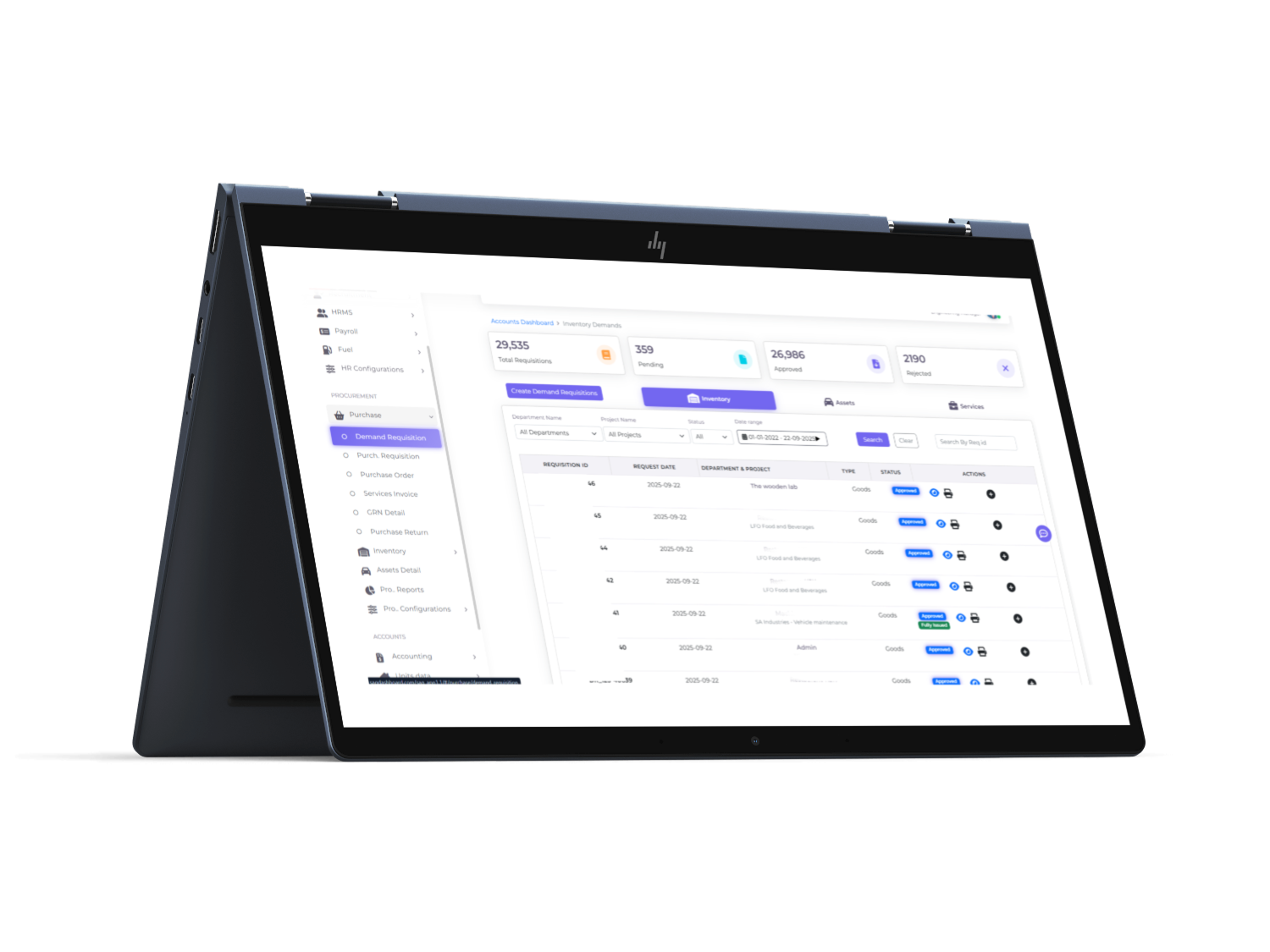
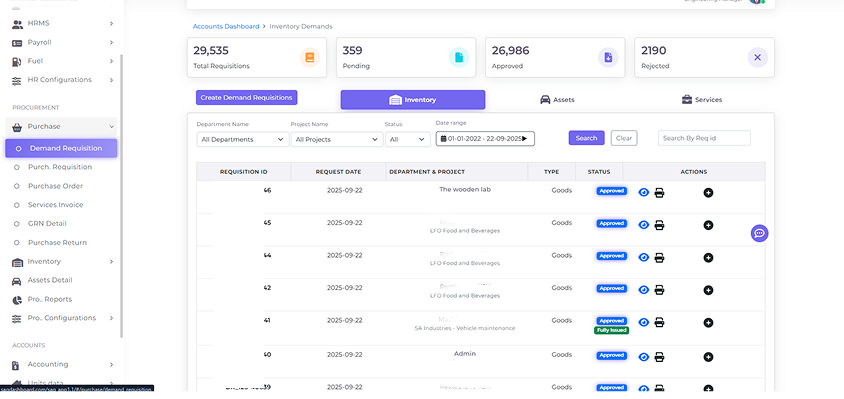
Purchase requisitions and approval chains
Departments raise requests for items or services, and each request moves through a pre-defined approval chain. Unnecessary purchases are stopped before they happen, and every approval is recorded against the person who gave it.
RFQs, quote comparison and purchase orders
Send requests for quotation to several suppliers from the system, compare the quotes side by side, and convert the chosen one into a purchase order. Each PO is tracked from creation to closure, so you can see what is ordered, from whom and what is still due.
Goods receipt, quality checks and invoice matching
Receipts are logged and matched to the purchase order, with inspection results recorded. Supplier invoices are then matched against the PO and the goods receipt before payment is approved, which reduces duplicate or incorrect payments. Purchase returns are recorded in the same flow.
Inventory and warehouse management across every location
Stock that is counted at month end is always out of date. Here, every receipt, transfer and adjustment updates stock as it happens, so purchasing, sales and finance work from the same numbers.
Multi-warehouse stock in real time
Track stock levels across multiple warehouses, branches and distribution centres from one dashboard. Incoming and outgoing items are recorded as they move, giving a single source of truth instead of one spreadsheet per site.
Stock requests, transfers and adjustments
Create and approve stock requests, move inventory between locations, and record damages, returns and write-offs as adjustments. Item variants such as sizes and colours are tracked individually, and barcode scanners can be used to add products and update stock.
Reorder alerts and minimum thresholds
Low-stock alerts warn you before a stockout, and purchase orders can be triggered when an item reaches its minimum threshold. Inventory aging reports show what is sitting on the shelf too long, helping you avoid both overstock and emergency buying.
Supplier management, cost control and reporting
Good sourcing decisions depend on history: which suppliers deliver on time, what you paid last quarter, and which contract is about to lapse. Our supply chain management software keeps that history in one place.
Supplier records, ratings and contracts
Maintain a central supplier database with contact details, pricing, ratings and contract history. Store contracts, rate agreements and SLAs with version tracking and renewal reminders, and monitor on-time deliveries to compare vendors fairly.
Cost center mapping
Map purchases to cost centers so spend is visible by department, not just by supplier. Combined with approval chains that validate requests against budget, it gives finance a clear view of what is being bought, from whom and for which department.
Procurement and inventory reports
Report on spend trends, supplier performance, pricing and delays, alongside stock summaries, product movement and valuation reports. Real-time notifications keep the right people informed when something needs action.
Real Business Impact
Leaner
Inventory Costs
Reduced with smarter stock planning
Faster
Delivery Time
Faster order fulfillment with integrated logistics
Automated
Procurement Efficiency
Automated approval cycles save time
Measured
Vendor Insights
Supplier ratings and SLA adherence tracked in one place
Take an Inside Look at our Supply Chain Management Software
Why Businesses Choose Our System
Simple, fast, and intuitive user interface
Access from any browser, on desktop or mobile
Multi-store and multi-user support
Compatible with your existing hardware
End-to-end ERP integration
SaaS supply chain software connected to sales and finance
A supply chain system that sits on its own just moves the re-keying somewhere else. Our supply chain management software is part of a wider ERP, so purchasing, stock, sales and accounts share the same records instead of being reconciled by hand every month.
We do not publish a list of supported integrations, because whether a system can be connected depends on its API access, your licence tier and your security requirements. Here is how we find out.
We map every system you run, the data each one holds and where your team re-keys it today.
We decide which system is the source of truth for each record.
We connect systems that offer a usable API or a reliable data export. Specific platforms are confirmed after a compatibility assessment, before any build is quoted.
You get a written integration plan, including anything we find cannot be connected reliably.
Historical records are cleaned and migrated, then reconciled against your existing data.
Who our supply chain management software is for
Supply chain businesses rarely slow down because of demand. They slow down because stock counts live in one spreadsheet, supplier terms in another, and nobody can say what an order really cost. If that sounds familiar, the system is built for teams like yours:
Distributors and wholesalers running several warehouses, where each location keeps its own version of the truth
Importers reconciling long supplier lead times against stock that is already committed
Manufacturers managing procurement, inventory and production supply in one system
Retail groups whose point of sale does not talk to stock or accounts
Operations managers who rebuild the same weekly stock report by hand
Businesses that have outgrown an off-the-shelf package but do not want a twelve-month ERP programme
How implementation works
We deliver remotely from our Lahore headquarters, in English, with named engineers rather than an account manager relaying messages. Implementation runs in stages, so you are never waiting months to see whether it works.
1
Discovery
We map the workflow as it actually runs today, spreadsheets included.
2
Architecture
Data model, integration plan and a phased rollout you sign off before build.
3
Build and migrate
Modules configured to your process, with historical data moved and reconciled.
4
Training and handover
Your team trained on the system, with documentation they keep.
5
Support
An agreed post-launch window, then an optional monthly support retainer.
Not sure where to start? A fixed-fee Paid Discovery Sprint turns your supply chain problem into a scoped, costed plan before anyone commits to a build.
Working with us from overseas
We deliver remotely from Lahore. These pages set out how that works in practice for each market — hours, language and where the boundaries are.
Supply Chain ERP software is a system that helps businesses manage and optimize their inventory, procurement, logistics, production, and overall supply chain operations efficiently.
It streamlines processes, reduces operational costs, automates workflows, improves inventory management, enhances supplier coordination, and ensures timely deliveries.
Key features include inventory management, order tracking, procurement automation, warehouse management, logistics planning, supplier management, and reporting dashboards.
Manufacturers, distributors, retailers, logistics companies, and any business involved in supply chain operations can benefit from ERP for improved efficiency and control.
Yes. Supply Chain ERP supports multiple warehouses, distribution centres, and locations, providing centralized control over inventory, shipments, and stock levels.
Yes. It can integrate with accounting software, CRM systems, eCommerce platforms, procurement tools, and other enterprise applications for seamless operations.
It tracks stock levels in real-time, automates reorder alerts, reduces overstock/stockouts, and provides accurate reports for better inventory control.
Absolutely. ERP software manages supplier data, tracks purchase orders, monitors vendor performance, and ensures timely procurement and deliveries.
Yes. Access is role-based, multi-factor authentication is available and can be enforced, and hosting and backups are agreed with you per project.
Implementation time depends on company size, the modules you need and how much data is migrated. We agree the timeline with you during discovery, before the build starts.
It is supply chain management software your team uses in the browser. We deploy it on the cloud hosting you choose or on-premises on your own servers, and your team signs in from a laptop or mobile device and works on the same live procurement, inventory, warehouse and supplier records from any location.
Systems that offer a usable API or a reliable data export. We do not publish a list of supported platforms, because whether a system can be connected depends on its API access, your licence tier and your security requirements. Specific platforms are confirmed after a compatibility assessment, and you receive a written integration plan before any build is quoted.
Yes. That is usually where projects start. During discovery we map the workflow as it actually runs today, spreadsheets included, and during the build your historical data is cleaned, migrated and reconciled against your existing records so the new system starts complete.
Each supplier invoice is checked against its purchase order and the goods receipt before payment is approved. If the quantities or prices do not line up, the mismatch is caught before money leaves the business, which reduces duplicate and incorrect payments.
We are headquartered in Lahore, Pakistan and deliver remotely. Delivery, documentation and support are in English, and you work directly with named engineers rather than an account manager relaying messages.
Custom source code and documentation are handed over to you on delivery, so you own them. Licensed ERP modules stay under their subscription terms.
Most clients start with a Paid Discovery Sprint: a short, fixed-fee engagement that maps your current systems, data and manual hand-offs and ends with a recommended architecture, a prioritised scope and a fixed-scope build estimate.
Request a Demo
Fill out the form and a supply chain specialist will contact you to schedule a personalized demo.
Want a Custom Supply Chain ERP?
SA Systems tailors each module to your specific workflow — whether you manage local distribution, retail inventory, or manufacturing supply chains.