
Israr Ahmed
Nov 27, 2025 • 9 min read
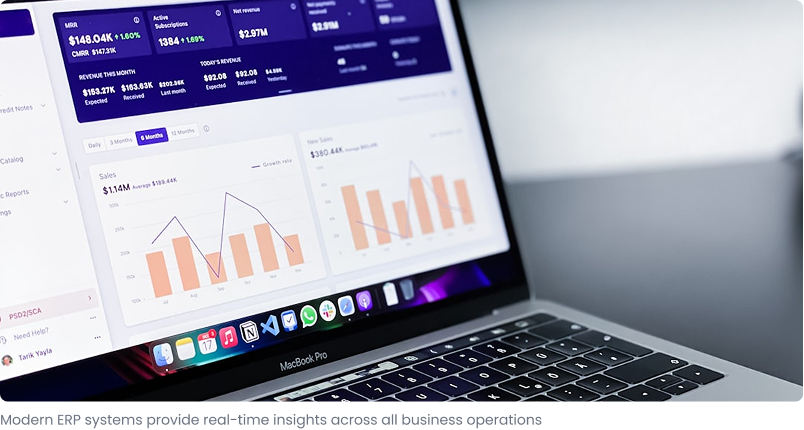
Discover the key benefits of ERP systems for businesses. Improve operational efficiency, enhance decision-making, reduce costs, ensure data security, and foster collaboration across departments with a centralized ERP solution.
ERP systems centralize and streamline core business processes into a unified platform. By connecting departments and automating routine tasks, they eliminate silos, reduce manual work, and standardize how your organization operates day to day.
Manual processes and disconnected tools often lead to duplicated effort and delays. ERP systems automate order processing, payroll, inventory updates, and report generation, reducing human error and freeing employees to focus on higher-value work.
Standardized workflows mean every order, approval, and request follows the same clear path. This cuts confusion, removes bottlenecks, and keeps operations moving smoothly across teams and locations.
Because data is updated in real time, managers can track key performance indicators (KPIs), monitor operations, and spot issues before they become problems. That visibility improves responsiveness and overall control.
ERP connects inventory, sales, and procurement, helping organizations maintain optimal stock levels, avoid overstocking or stockouts, and lower holding costs through accurate forecasts and automated reorder alerts.
By removing duplication, errors, and manual handoffs, ERP reduces operating expenses while improving collaboration between sales, finance, HR, and operations—all working inside the same system.
ERP is also a powerful financial engine. Consolidated data and real-time visibility make it easier to control costs, protect margins, and plan for growth.
Automation and process optimization reduce labor costs, rework, and waste. Integrated supply chain and inventory controls prevent excess stock, rush orders, and other avoidable expenses.
ERP consolidates financials from every department into a single ledger. Teams can generate up-to-date P&L statements, cash flow reports, and balance sheets without manual reconciliation, reducing the risk of errors and compliance issues.
With centralized data, leaders can build more accurate budgets, model scenarios, and monitor spending in real time. Visibility into receivables, payables, and inventory costs strengthens cash flow management and long-term ROI.
ERP systems are built to scale as you add new business units, regions, or product lines. The combination of efficiency gains, cost savings, and better financial control compounds over time into a strong return on investment.
Modern ERP platforms are decision engines. By centralizing and structuring data, they give leaders the insight needed to act quickly and confidently.
ERP integrates data from finance, HR, sales, inventory, procurement, and more. Everyone works from the same numbers, eliminating conflicting reports and time spent reconciling spreadsheets.
Instead of waiting for end-of-month reports, leaders can see what is happening right now. Real-time dashboards and alerts help teams respond faster to market changes, customer needs, or supply chain disruptions.
Built-in analytics and BI tools turn raw data into KPIs, trends, and forecasts. Combined with strong data integrity, audit trails, and role-based access, ERP supports smarter, compliant decision-making across the organization.
ERP does more than automate processes—it reshapes how people work together and how the organization executes strategy.
Because every department operates on the same platform, teams can collaborate with shared context and metrics. Leaders can align day-to-day operations with long-term goals, ensuring strategy is visible in the way work actually gets done.
Centralized customer histories, order data, and service records help teams respond faster and personalize interactions. On the supply side, integrated procurement and logistics make it easier to coordinate with vendors and partners.
Self-service tools, clear workflows, and accurate data reduce frustration and manual admin work. Employees can onboard faster, track their performance, and focus on impactful tasks, while the organization scales without losing control.
ERP systems integrate operations across departments, providing real-time insights and automated workflows.
They enhance efficiency, reduce costs, and improve decision-making across finance, HR, operations, and customer service.
ERP is scalable and flexible, supporting both small and large businesses in achieving strategic growth.
While implementation requires planning and investment, the long-term operational, financial, and strategic benefits make ERP systems indispensable for modern organizations.
To unify core business processes on a single platform and provide accurate, real-time information for efficient, coordinated operations.
By automating manual tasks, reducing errors, and giving employees the tools and data they need to focus on higher-value work.
Yes. Modern ERP platforms are modular and scalable, so smaller organizations can start with core functions and expand as they grow.
Common causes include weak planning, limited user training, lack of executive sponsorship, and choosing a system that does not match real business needs or processes.
Typical modules include Finance & Accounting, HRMS, Inventory & Supply Chain, CRM, POS, Real Estate & Property Management, and Project Management.


Israr Ahmed
Product Strategist at SA Systems
Israr helps organizations design ERP strategies that balance operational efficiency with long-term scalability and control.
 ERP
ERPMarch 15, 2025
 ERP
ERPFebruary 28, 2025
.png) ERP
ERPJanuary 20, 2025
.png) Real Estate
Real EstateDecember 10, 2024